Sound Quality
Chord Electronics approaches digital-to-analog conversion differently from virtually every other manufacturer. Where competing DACs use off-the-shelf ESS or AKM DAC chips, Chord writes its own processing algorithms and implements them on an FPGA — a programmable logic chip that allows Chord’s engineers to implement proprietary filter designs and noise-shaping algorithms that no chip manufacturer offers as a standard product. The result is a measurably and audibly different approach to digital audio that has earned the Mojo platform a devoted following among audiophiles who have directly compared it to chip-based alternatives.
The sonic character of the Mojo 2 is characterized by extraordinary coherence. The boundary between instruments is precisely defined, the timing of transients is exact, and the sense of three-dimensional space within recordings is rendered with a precision that is immediately apparent. Listening to the Mojo 2 after returning from a chip-based DAC at a similar price point, many listeners describe a sense of increased presence and realism — a quality sometimes called PRaT, sometimes called “analogue-like,” but fundamentally a property of the processing architecture rather than any deliberate tonal tuning.
Bass extension is deep and linear. Midrange is transparent and natural. Treble is extended and clean without the slight glare that can affect chip-based designs at high frequencies. The noise floor is vanishingly low. Paired with the Sennheiser HD 650 or the Audeze LCD-2 Classic, the Mojo 2 reveals layers of recorded information that other portable sources miss entirely.
Build & Ergonomics
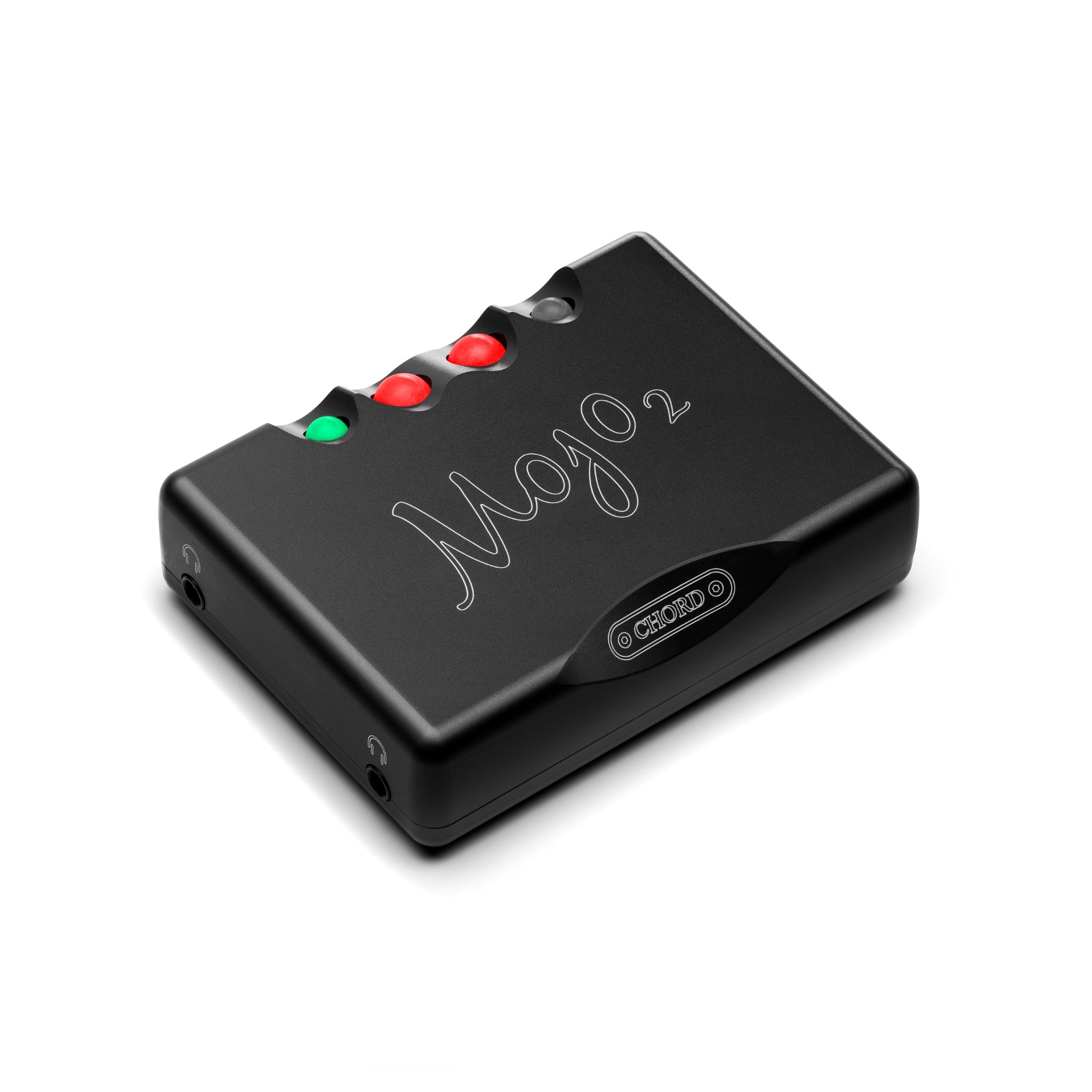
The Mojo 2 is machined from a single block of aluminum, which explains both its premium feel and the warmth it generates during extended use — the aluminum chassis serves as a heat spreader for the FPGA inside. The build quality is exceptional: precise machining, tight tolerances, and a premium feel that belies its portable form factor.
The control interface — the spherical buttons that change color to indicate volume, sample rate, and settings — is Chord’s most controversial design decision. It is elegant in concept: the colorful glowing balls are visually distinctive and communicate information efficiently once learned. In practice, the learning curve is real. First-time users regularly struggle to understand the interface without the manual. Once mastered, however, it becomes second nature, and the information density it provides (input source, sample rate, output level, battery status) through simple color changes is genuinely efficient.
The parametric EQ system, new in the Mojo 2, allows four-band shelf and peak EQ adjustments through the ball interface. Once dialed in for your specific headphones, the EQ settings are stored and recalled automatically on power-up.
Value Proposition
At $499, the Mojo 2 is expensive for a portable DAC/amplifier but genuinely competitive as a desktop DAC/headphone amplifier. The FPGA-based processing, the drive capability for high-impedance headphones, and the resolution it extracts from digital sources represent performance typically found in components costing $700–1,200. The battery-powered portability is a bonus rather than the primary use case for most owners.
For headphone listeners who want to extract maximum performance from their cans at home while retaining the option for mobile use, the Mojo 2 is a rare product: one where the technical ambition of the designer is fully audible in the output. Pair it with a Poly wireless streaming module and it becomes a complete wireless headphone system; use it at a desk fed by a laptop USB and it will outperform most dedicated desktop DACs at the price.